banner

Evaluation on Professional Capacity Building

Evaluation on Professional Capacity Building

The Programme and Beneficiaries

Professional capacity building programmes in the Phase II Project (2019 – 2021) were mainly provided by the Chinese University of Hong Kong (CUHK) Jockey Club Institute of Ageing (IoA), the Hong Kong Association of Gerontology (HKAG), and the University of Hong Kong. While most of the training programmes of CUHK IoA were delivered in hospitals in New Territories East cluster, the programmes of HKAG were tailor-made for residential care home for the elderly (RCHEs), and the programmes of the University of Hong Kong targeted health and social care professionals in various community settings.

Over the 3 years in the Phase II Project, the CUHK had offered over 300 activity sessions to cover 30 000 participants from both the public and the healthcare sector. These trainings were delivered in the formats of seminars, lectures, symposium, online training, or train-the-trainer sessions. The CUHK team also developed various training and educational materials such as videos and booklets. On the other hand, the HKAG delivered a two tiers of structured training programme, one targeting health and social care professionals, and another targeting support care staff, in the RCHEs. Between 2019 and 2021, HKAG had delivered 382 sessions of basic EoLC training to 1 833 professional staff and support care workers in over 48 RCHEs to build their capacity to provide EoLC to their residents. Further 78 sessions of advanced training were provided to 310 RCHE staff, and 22 sessions of capacity building programme were delivered to 176 visiting medical officers.

The capacity building programmes in the University of Hong Kong were delivered by either the School of Nursing or the Faculty of Social Sciences. A programme composed of an entry level and an advanced level was developed by the School of Nursing benefiting 717 community nurses. A training manual was published based on this training programme that benefited 500 nurses in 2021. The capacity building programmes of the Faculty of Social Sciences can be categorised into three types –

Long-term programme
Intermediate-term programme
short-term programmes

Under the long-term programme, a 10-month leadership training targeting middle management and service development personnel in related healthcare and social care field was delivered with a purpose to cultivate future leaders in community EoLC. Twenty-nine leaders nominated by 21 NGOs completed the programme and developed their proposals on EoLC-related projects. Under the intermediate-term programme, the Faculty of Social Sciences developed a flagship 3-tiered standardised community psychosocial EoLC programme consisting of a basic online module, and an intermediate module and an advanced module which are delivered in a flipped classroom format. The programme covered 7 core competencies in EoLC, and benefited over 3 600 health and social care professionals by the end of 2021. Regarding short-term programmes, the Faculty of Social Sciences tailor-made various training for specific service settings (e.g. elderly community service units, police force) and target groups (e.g. EoLC volunteer coordinators, social work students), or on specific topics (e.g. family intervention, symptom management, psychosocial care etc.), with over 1 900 participants.  Besides, to prepare trained manpower for implementing the integrated community end-of-life care support teams (ICESTs), training programmes on ICESTs model were also delivered to 69 selected professional staff and support care staff, and 3 manuals were developed on the ICEST model.

This report focuses on the capacity building programmes delivered by the Faculty of Social Sciences, the University of Hong Kong. Details on the evaluation on the CUHK IoA programmes can be accessed here.

Methodology

Evaluation on the Faculty of Social Sciences’ professional capacity building programmes was conducted on two levels, one on the outcome level and another on the impact level. On the outcome level, changes in EoLC competence of participants in the training programmes were assessed with either a pre-post course or pre-post-followup study design using standardised questionnaires. A standardised assessment tool on EoLC competence which encompasses 7 competence domains was used for evaluating the effectiveness of the 3-tiered community psychosocial EoLC programme in promoting participants’ competence in providing EoLC. In other courses, specific competence items were developed based on the expected learning outcomes. Participants were asked to self-assess their perceived competence level before the training programme as well as after completing the programme. Paired t-tests were employed to evaluate the changes in EoLC competence. On the impact level, 3 waves of annual online survey targeting health and social are professionals were conducted in 2019, 2020, and 2021. The surveys aimed at gauging the level of self-perceived EoLC competence among health and social care professionals in the community. In each year, invitation email on this survey were sent to a vast of health and social care professionals via the network of respective professional bodies and associations for doctors, nurses and social workers. The number of responses received were 470, 328, and 357 in 2019, 2020, and 2021 respectively.

Achievements

Long-term Programme

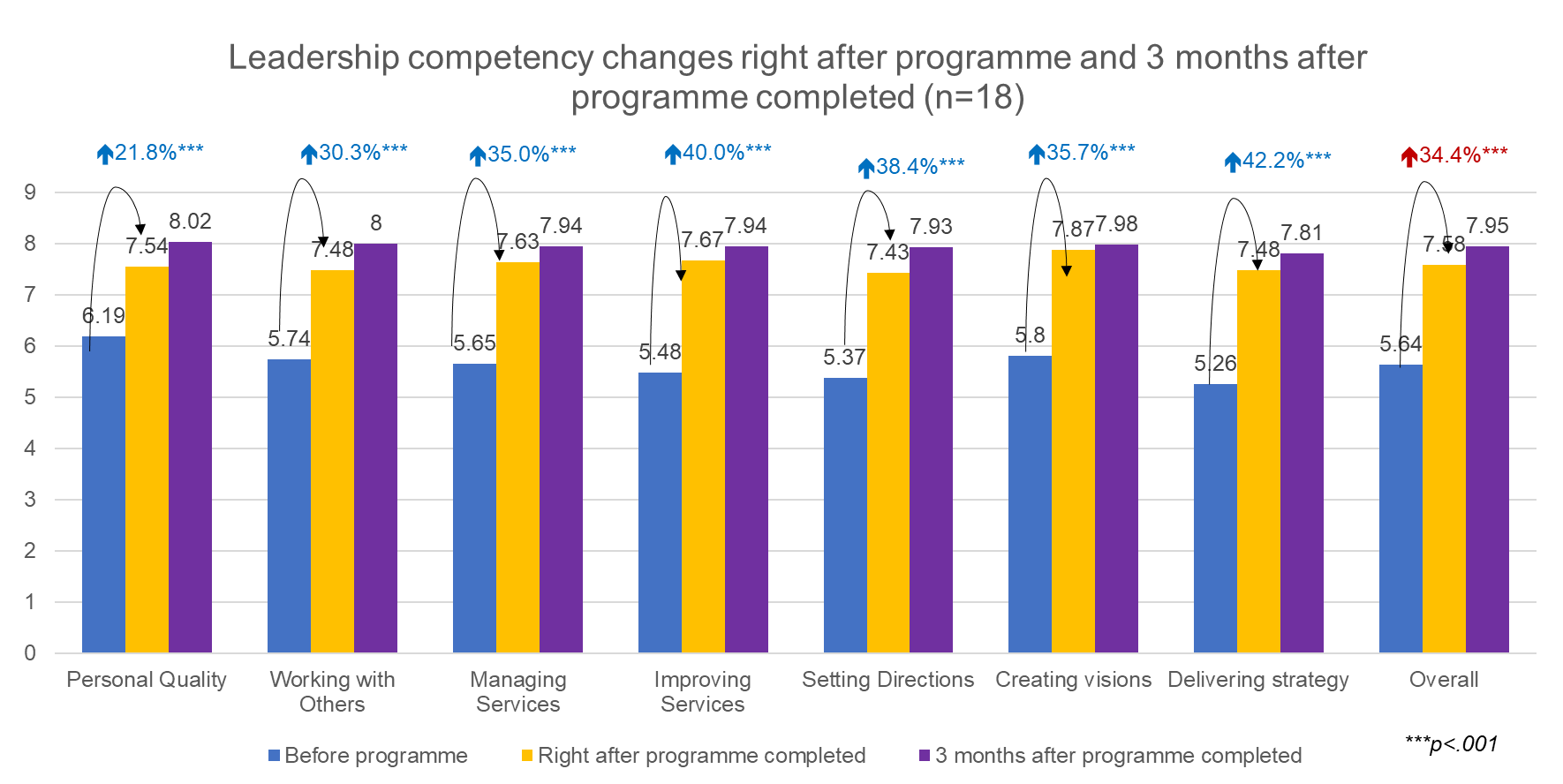
Leadership competence were assessed among 18 leaders in the leadership training before the commencement of the training, right after the completion of training, and 3 months after the completion of training. Assessed leaders showed significant changes in all aspects of their leadership competencies after the training with an overall 34.4% improvements (Figure 1). Upon follow up evaluation, further improvements were observed in all competencies compared to the post-test although not yet reaching statistical significance.

Paired t-tests on leadership competence before and right after programme completion in leadership training programme (n=18)

Intermediate-term Programme

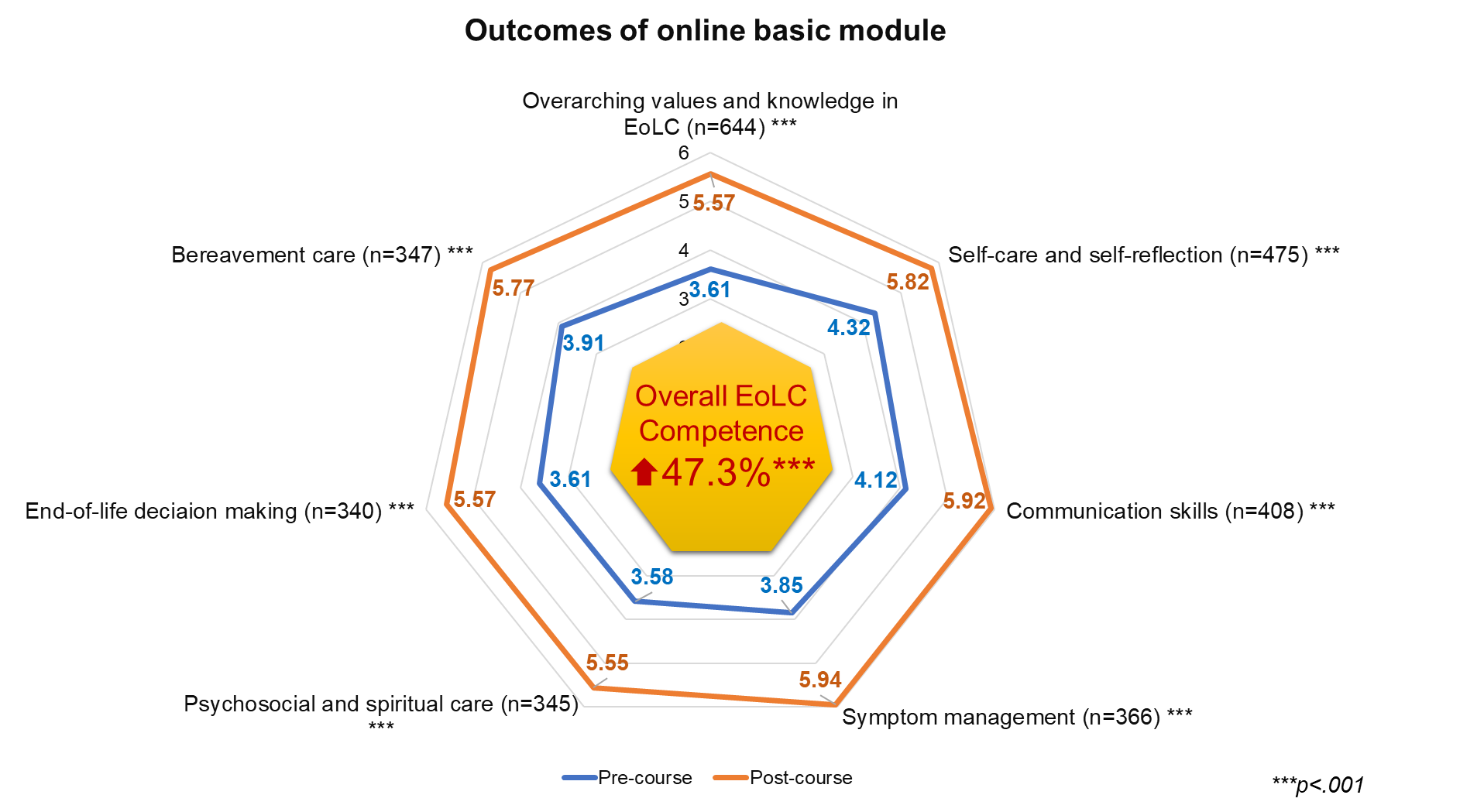
Pre-post course evaluation was adopted in the online basic module in the 3-tiered community psychosocial EoLC programme. Participants showed significant improvements in all EoLC competence domains with an overall improvement as great as 47.3% (p<.001).

Paired t-tests on pre and post course EoLC competence among participants in online basic module


Short-term Programmes

Pre-post course evaluation was used in all types of short-term training programmes. All training programmes were effective in enhancing participants’ competence in providing EoLC. Specifically, the 18 workshops on specific EoLC topics produced 26.2% (p<.001) improvements in EoLC competence of health and social care professionals; Training for community elderly service units resulted in 33.8% (p<.001) and 17.2% (p<.001) improvements in EoLC competence in professional workers (n=142) and support care workers (n=39) respectively; Assessed professional workers (n=43) and support care workers (n=25) in the ICEST model training showed 59.9% (p<.001) and 17.2% (p<.001) enhancement in their competence in implementing ICEST model; and assessed social work students (n=136) in our training reported a significant improvement in EoLC competence by 68.0% (p<.001) .

Short-term programmes

Workshops on specific topics(18 courses)

  • EoLC competence(n=446)

    26.2%

Training for community elderly service units

  • professional workers EoLC competence

    33.8%

  • Support workers EoLC competence

    17.2%

Training on iCEST model

  • professional workers ICEST competence

    59.9%

  • Support workers ICEST competence

    17.2%

Social work student training

  • EoLC competence

    68.0%

Impacts

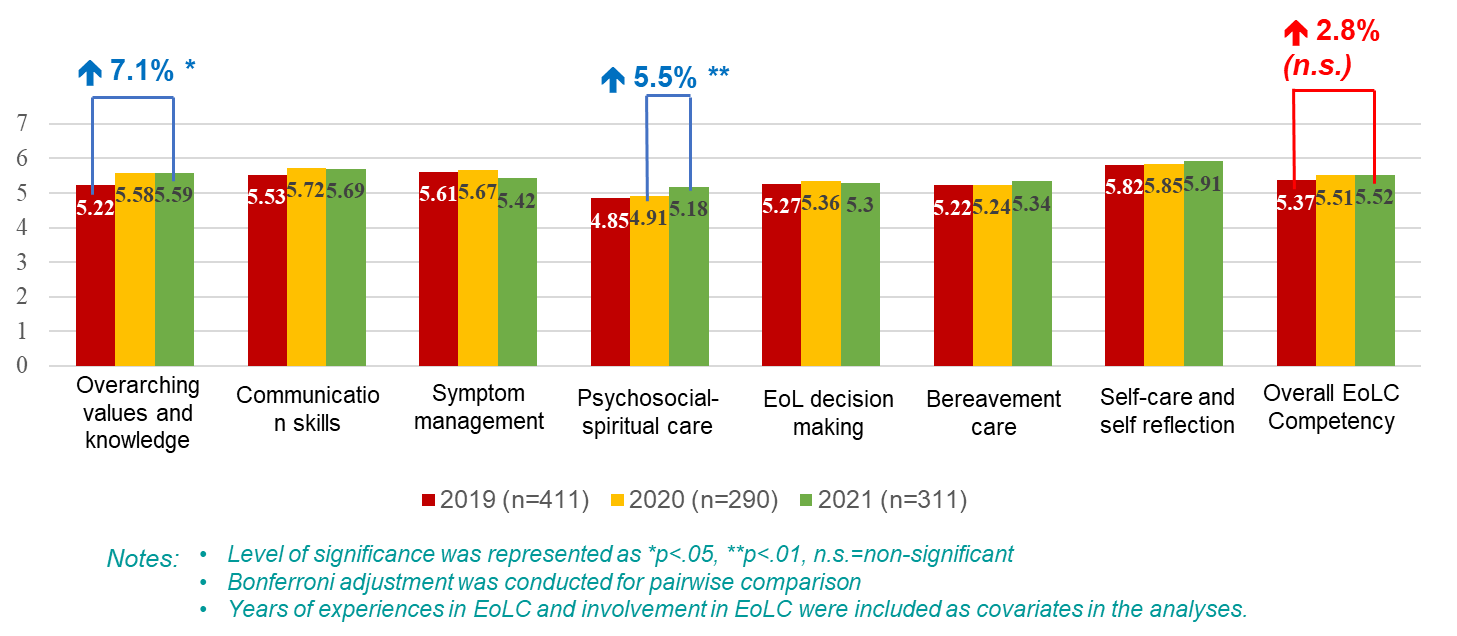
The annual survey with health and social care professionals in the community showed that after controlling the EoLC experience of respondents, respondents in 2021 reported 7.1% higher competence in overarching values and knowledge on EoLC compared to those in 2019 (p<.05), and 5.5% higher competence level on psychosocial-spiritual care than those in 2020 (p<.01) .

Respondents were also asked if they have participated in any JCECC capacity building programmes. Level of EoLC competence was compared between participants and non-participants (Figure 5). Respondents who have participated in JCECC capacity building programme(s) reported significantly higher levels of competence in all EoLC competence domains except symptom management. The overall EoLC competence of programme participants were 16.4% (p<.001) greater than non-participants.

Learnings in phase II and way forward in phase III project

  • Both the outcome evaluation and impact assessment on the professional capacity building programmes lent support to the effectiveness of JCECC Capacity building programmes in promoting EoLC competence of health and social care professionals in the community.
  • The most prominent milestone in the professional capacity building in the Phase II project is the development of a standardised 3-tiered curriculum on community psychosocial EoLC. The programme is sustainable due to its online nature, which was unaffected during the COVID-19 pandemic. Another advancement in the Phase II project professional capacity building programme was the development of tailor-made programmes for specific settings or target groups, such as the training for community elderly service units, the training for EoLC volunteer coordinators and social work students. Our findings suggested that these tailored programmes successfully enhanced participants’ competence in EoLC regardless of their role and degree of involvement in EoLC and should be continued.
  • The ICEST model training is another signature capacity building programme in JCECC for it will prepare trained manpower to deliver ICEST services even after the JCECC project is completed. The current findings supported the effectiveness of the training in enhancing professional workers and support care workers’ competence in delivering ICEST. Nevertheless, more advanced training on ICESTs have to be developed in order to allow health and social care professionals to practice the clinical skills in the model. These training should be developed in the next phase.
  • Our evaluation also supports the effectiveness of the leadership training programme in promoting leadership skills among future leaders in EoLC. Given that the leadership programme in Phase II project ended with service proposals, future programme may support these alumni in turning their proposals into real actions.

images
A A A