



- World Health Organization. (n.d.). Palliative care. World Health Organization. Retrieved November 17, 2022, from https://www.who.int/teams/integrated-health-services/clinical-services-and-systems/palliative-care
- Chung, R. et al. (2017). Knowledge, attitudes, and preferences of advance decisions, end-of-life care, and place of care and death in Hong Kong. A population-based telephone survey of 1067 adults. Journal of the American Medical Directors Association; 18(4), 367.e19
- World Health Organisation. Fact Sheet No. 402: Palliative Care. 紓緩治療平台 – 主頁. (n.d.). https://www21.ha.org.hk/smartpatient/PalliativeCare/zh-hk/Home/
- General Medical Council. (2010). Treatment and care towards the end of life: good practice in decision making. Retrieved from https://www.gmc-uk.org/-/media/documents/Treatment_and_care_towards_the_end_of_life___English_1015. pdf_48902105.pdf
What is EoLC ?
紓緩治療 (Palliative Care)
According to the World Health Organization¹, palliative care is a method of caring for patients with critical illness and their families/carers, with the aim of improving their quality of life. Palliative care prevents and relieves suffering through early identification, assessment and management of pain and other physical, psychosocial or spiritual problems. Palliative care uses a cross-team approach to support patients until death. It also provides appropriate support to family members during the process and provides grief counseling after the patient’s death.
Palliative care is targeted at patients with critical illness, including cancer or other chronic diseases such as renal failure, chronic respiratory diseases, cardiovascular and neurological diseases, etc. Designed to provide holistic physical, psychological, social and spiritual care to patients and their families suffering from critical illness. The HA uses an inter-professional team, including doctors, nurses, medical social workers, clinical psychologists, physiotherapists, occupational therapists, etc., to provide appropriate palliative care services to patients and their families in an integrated service model. The purpose is to Improve their quality of life and help patients spend the last part of their lives more peacefully.
Many people in society have misunderstandings about palliative care. They believe that palliative care is equivalent to late stage care or giving up treatment², and that it is only suitable for patients who have entered a later stage of the disease or are about to die. In fact, palliative care is also applicable to the early stages of critical illness and can be used in parallel with curative treatment. It aims to relieve symptoms caused by the disease and treatment, such as pain, fatigue, asthma, nausea, depression, etc., and relieve the patient’s symptoms. of physical and mental pain. In the early stages of illness, palliative care can effectively improve patients’ quality of life and reduce unnecessary hospital admissions³. When a patient is near death, palliative care services also include late-life care. Therefore, palliative care is an indispensable part of the entire medical care process.
安寧照顧 (End-of-Life Care)
When a patient is diagnosed with an incurable disease and is likely to die within the next 6 to 12 months. Palliative care generally refers to providing palliative care to such patients until the end of life (palliative care includes but is not limited to palliative care), including:
- Imminent death (expected to die within hours or days) and the following persons
- Have a severe and progressive life-limiting disease (e.g. advanced cancer, advanced motor neuron disease
- 整體身體虛弱和同時患有多種疾病,預計病人會在 6 至 12 個月內死亡
- 患有可能因急性病發而導致死亡的疾病
安寧照顧旨在幫助病人舒適地走完人生最後一程,達致安然善別。同時,安寧照顧會為病人減輕疼痛、控制症狀以及提供心理社交和心靈支援,提升病人及家人的生活質素 ; 還包括各項醫療和社會照顧服務,例如疾病的專科治療、紓緩治療和寧養照顧等。
寧養照顧 (Hospice Care)
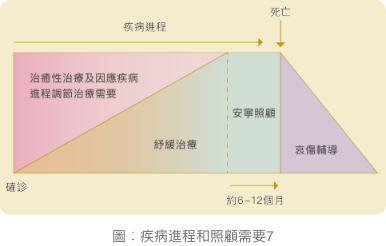
寧養照顧相等於臨終關懷,主要針對的對象為臨終病人(即預期壽命一般少 於 6 個月或更短),以及已經採取過一切治癒性治療的病人5 。寧養照顧的首要目標會由延長壽命過渡至提升病人臨終前的生活質素。寧養照顧的服務包括 紓緩照顧以及其他全面的照顧和治療,例如藥物治療、心理社交和心靈上的支援等。此外,寧養照顧亦會照顧家人在面對疾病和死亡過程中的各項需要,協助他們調適生活上的困難
- Hospital Authority. (2017). HA strategic service framework for palliative care. Retrieved from https://www.ha.org.hk/haho/ho/ap/PCSSF_1.pdf
- Institute of Medicine of the National Academies. (2015). Dying in America: Improving quality and honouring individual preferences near the end of life. Washington, DC: The National Academies Press.
- 香港中文大學賽馬會老年學研究所 (2020) 。<<安寧服務培訓及教育計劃:醫護人員培訓手冊>>。香港︰作者。
「預設照顧計劃」 (Advance Care Planning, ACP)
「預設照顧計劃」是指患有嚴重疾病的病人和家屬與醫護人員透過溝通,考慮到疾病的預後、治療的利與弊、病人的價值觀和意願等因素,來商討日後病危時的醫療及個人照顧計劃。
一般「預設照顧計劃」的溝通對象是精神上能夠自決的成年病人,並歡迎家屬參與。病人可表達本身對未來醫療或個人照顧的意願,或作出拒絕接受維生治療的「預設醫療指示」。
在醫院管理局,「預設照顧計劃」也涵 蓋精神上不能自決的病人及未成年病人。 醫護人員與病人家屬可根據病人的最佳利益,謀求共識,為病人計劃未來的醫 療或個人照顧。
「預設照顧計劃」的目的
預設照顧計劃是事先及通盤表達對醫療及個人照顧意願的過程,以決定病人往後及晚 期的照顧。透過預設照顧計劃過程:
- 精神上有行爲能力及妥為知情的病人可:
- 表達其價值觀、信念和願望;
- 表達本身對未來醫療或個人照顧的意向;
- 作出拒絕接受維持生命治療(包括「不作心肺復甦術」)的預設醫療指示#;
- 委托一名家庭成員作為主要聯絡人,以便日後作諮詢。
- 精神上無行爲能力的成年病人或未成年病人,其家人與醫護團隊可根據病人的最 佳利益,同時顧及病人曾表達的願望、意向和價值觀,並衡量現有選擇的好處、 風險和負擔,尋求共識,為病人制訂未來的醫療或個人照顧計劃。
- 當病人日後病情惡化,病人及其家人可以有較充足心理準備。
「預設照顧計劃」的好處
實踐病人知情權 :
病人需要醫護人員提供足夠資料,包括疾病的預後和維生治療的利弊,釐清對「不施予維生治療」的 意義,才能作出知情選擇。這是好機會讓病人及家 屬深入了解病情。
體現病人自主 :
現代的醫療注重病人的參與,精神上有能力作出決定的成年病人都具有其醫療自決的法定權益,包括 拒絕或接受特定治療護理。「預設照顧計劃」為末期病人提供自主的機會,病 人可以未雨綢繆,表達個人價值觀和意向,拒絕無 效維生治療,到日後缺乏自主能力時,決定會得到 醫護人員及家屬的尊重。
符合病人最佳利益 :
病人的最佳利益不單只從醫療角度考慮,他們的意 願是十分重要的考慮因素;如病人無法表達自己, 可參考家人和照顧者的意見,得知病人的價值觀、 意願、文化及宗教信仰等等以推定病人最佳利益。
避免日後爭議 :
醫護人員、病人、家屬和照顧者,大家對生命及維 生治療的看法都可能有所不同。如果大家及早處理 矛盾和衝突,透過坦誠的溝通和協商,確認病人的 意願,就能避免醫護人員和家人在病人生死徘徊之 際,仍要因抉擇而發生衝突和矛盾,也讓病人有安 然離世的權利。
促進家庭關係 :
在討論過程中,醫護人員會鼓勵和引導病人表達自 己的價值觀及意向;這些看法,病人在家中可能甚 少或苦無機會談及。如家屬能對病人加深了解,得 知病人的意願後,便可以更配合和安心地提供適切 的照顧。
減少臨終痛苦:
病人為自己選擇了免卻無效維生治療而自然和有尊 嚴地離世,除了可以減少病人不必要的痛苦,亦能 紓解家屬的哀傷。
預設醫療指示 (Advance Directive, AD)
預設醫療指示是一種書面形式作出的陳述。年滿十八歲、精神能自主及知情的病人可訂立「預設醫療指示」,清晰闡述當病人到生命末段而不能自決時,在甚麼特定情況下拒絕那些「維持生命治療」。在普通法制度下,有效和適用的「預設醫療指示」有法定效力。透過預設醫療指示,人們得以向醫護人員及家人清楚表明他們的意願。例如,一個末期癌症患者可透過預設醫療指示,指明他一旦心跳停頓時,不接受心肺復甦法等的急救。
「維持生命治療」指任何有可能延遲病人死亡的治療,例子包括使用心肺復甦法、人工輔助呼吸、血液製品、心臟起搏器及血管增壓素、為特定疾病而設的專門治療(例如化學治療或透析治療)、在感染可能致命的疾病時給予抗生素、以及人工營養及流體餵養。(人工營養及流體餵養指透過導管餵飼食物和水份。)香港現時並沒有法例規定預設醫療指示要以何種形式表達,但是醫院管理局有特定的「預設醫療指示」表格,供醫管局病人使用,表格涵蓋以下情況:
第1類情況「病情到了末期」
指患有嚴重、持續惡化及不可逆轉的疾病,而且對針對病源的治療毫無反應,預期壽命短暫,僅得數日、數星期或數月的生命;至於施行維持生命治療的作用,只在於延遲死亡一刻的來臨。
第2類情況「持續植物人狀況或不可逆轉的昏迷狀況」
第3類情況「其他晚期不可逆轉的生存受限疾病」
這是指不劃入第1 或第2類的嚴重、持續惡化及不可逆轉疾病,而病情已到了晚期,及生存受限,例子包括:(1)晚期腎衰竭病人、晚期運動神經元疾病或晚期慢性阻塞性肺病病人,因他們可能用透析治療或輔助呼吸治療維持生命,而不劃入第1類;以及(2)不劃入第2類的不可逆轉主要腦功能喪失及機能狀況極差的病人。
見證人
醫管局的「預設醫療指示」表格必須由病人和兩名見證人簽署,其中一名見證人必須是香港註冊醫生,而兩名見證人均不得在預設醫療指示作出者的遺產中有任何權益。
